The Pygmy goat is one of the most popular pet goat breeds in Europe, North America and beyond. Small, sturdy, sociable and full of personality, it adapts equally well to rural settings and suburban gardens. This complete guide tells you everything you need to know before bringing one home.
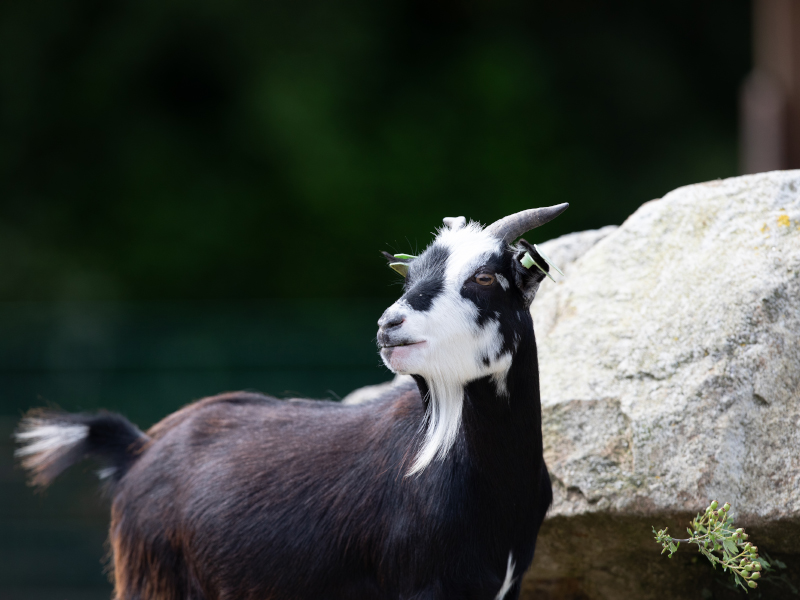
Chèvre Pygmy africaine — une race miniature attachante
🐐 Breed Profile — Pygmy Goat
Origins and History
The Pygmy goat originates from West Africa, primarily Cameroon and neighboring countries in the Congo Basin. It belongs to the West African Dwarf group — a family of breeds adapted to humid, tropical environments over thousands of years.
Imported to Europe in the 1950s and 1960s for zoos and wildlife parks, the breed quickly became popular as a pet thanks to its compact size and accommodating temperament. In the United States, the National Pygmy Goat Association (NPGA) was founded in 1975 to codify breed standards.
Appearance and Breed Standard
The Pygmy is characterized by a short, compact and heavily muscled body that appears disproportionately stocky for its small size. The head is short with a straight to slightly dished profile. Horns, present in both sexes in the wild, are often disbudded in pet settings for safety.
Accepted coat colors
- Agouti (or caramel): the most common, with a dark dorsal stripe and lighter markings on the face, belly and legs
- Black: uniform black with or without white markings
- Brown: various shades of brown
- White: rare but accepted by some associations
Temperament and Behavior
The Pygmy is famous for its extremely playful temperament and boundless curiosity. Contrary to some beliefs, Pygmy goats are not solitary animals — they absolutely need a companion (another goat, or at minimum a sheep or rabbit) to thrive.
They bond well with humans and can become very attached to their keepers when handled from birth. They are remarkably intelligent: they quickly learn to open latches and find ways around barriers — sturdy, well-designed fencing is essential!
Feeding
Like all goats, the Pygmy is a browsing ruminant that thrives on variety. The diet base is good-quality hay (grass or mixed meadow hay), available ad libitum. A small concentrate supplement (goat pellets) can be added depending on the animal's physiological stage.
- Hay ad libitum (grass, meadow hay)
- 100–150 g of goat pellets per day (outside gestation and lactation)
- Free-access minerals (salt block + goat-specific mineral mix)
- Fresh water always available
- Treats: apples, carrots, willow leaves (in moderation)
Strictly avoid: toxic plants (oleander, boxwood, rhododendron, elderberry), concentrate overfeeding (enterotoxemia risk), unsupplemented grains.
Health and Longevity
The Pygmy is a particularly hardy breed, well suited to European and North American climates. Life expectancy is 10 to 15 years with good care. Key health watch-points:
- Internal parasites (barber pole worm, liver fluke): use FAMACHA scoring or fecal egg counts to guide targeted deworming
- Enterotoxemia (CDT): annual vaccination strongly recommended
- Hoof problems: regular trimming every 2–4 months
- Obesity: risk in confined animals with unlimited concentrate access
Reproduction
The Pygmy is polyestrous: unlike some goat breeds, it can cycle year-round, though autumn remains the peak breeding season. Gestation averages 148 to 150 days. Twin and triplet births are common.
Recommended first breeding age is 7 to 9 months for does (when they reach at least 60% of adult weight), and 5 to 6 months for bucks.

Groupe de chèvres Pygmy : une race particulièrement sociable
Manage your Pygmy goats with CapriGen
Record pedigrees, calculate inbreeding coefficients and track matings for your Pygmy herd. Free to get started.
🐐 Try CapriGen free